5 Common Problems in High-Volume Returns and Solutions
High-volume returns drain 8–12% of revenue through restocking delays and misrouted shipments. These 5 fixes cut processing time by 41% → Full breakdown →
Hylke Reitsma is co-founder of Forthsuite and a supply chain specialist with 8+ years of hands-on experience at Shell, Verisure, and Stryker. He holds an MSc in Supply Chain Management from the University of Groningen and writes practical guides to help e-commerce teams run leaner, faster supply chains. Selected by Replit as 1 of 20 founders for the inaugural Race to Revenue Cohort #1 (2026) and certified as a Replit Platform Builder.
TL;DR: Returns are expensive and time-consuming, especially for ecommerce businesses handling high volumes. Forthroute gives Shopify merchants a branded returns portal with merchant-controlled approvals, refunds and exchange incentives, plus optional prepaid labels.
Last updated: July 2026
Returns are expensive and time-consuming, especially for ecommerce businesses handling high volumes. NRF and Happy Returns put total US retail returns at $890 billion of merchandise for 2024, or 16.9% of annual retail sales - a figure for all of retail rather than online alone, and the value of the goods coming back rather than what the returns cost to handle. Manual processes, poor automation and inefficient systems make the handling worse, leading to slow refunds, lost revenue and frustrated customers.
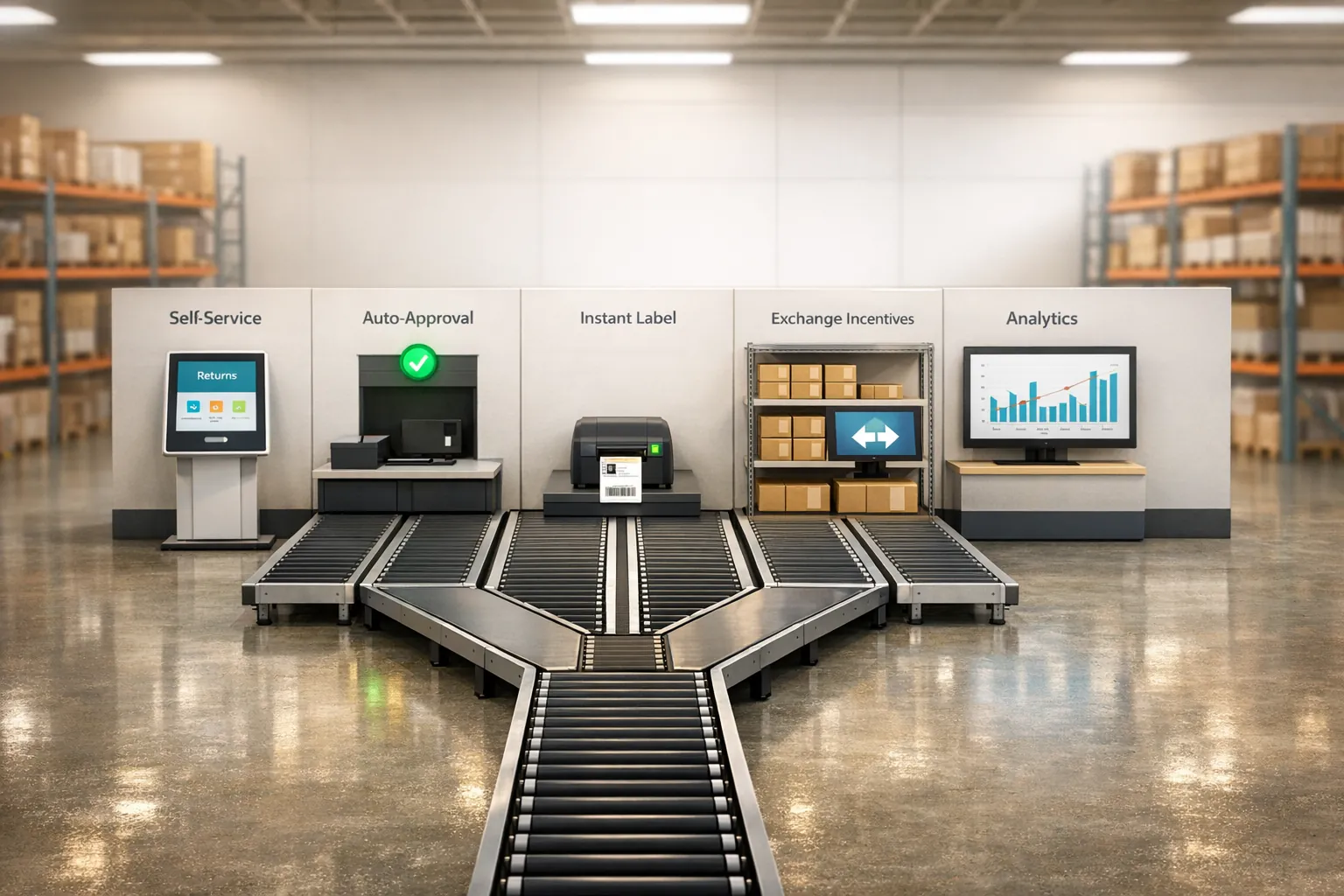
Here’s a quick breakdown of the 5 biggest return challenges and how to solve them:
-
Manual Processing Overload: Support teams waste time on repetitive tasks like emails and label generation.
Solution: Use self-service return portals to automate approvals and streamline workflows. -
High Refund Rates: Refunds eat into revenue, especially for issues like sizing.
Solution: Encourage exchanges with automated product recommendations and store credit incentives. -
Inconsistent Approvals: Manual decisions lead to fraud risks and policy loopholes.
Solution: Apply automated approval rules for fairness and fraud prevention. -
Slow Label Generation: Delays in creating return labels slow inventory restocking.
Solution: Automate instant prepaid and QR code label generation. -
Lack of Data Insights: Missing return data prevents process improvements.
Solution: Track return metrics to identify trends and fix recurring issues.
Automation is the key to faster returns, higher customer satisfaction, and better revenue retention.
Returns Management Software Turns Refunds Into Revenue - Here’s How
sbb-itb-a3e286c
Problem 1: Manual Processing Overloads Support Teams
When returns are managed through email, support teams often find themselves drowning in administrative tasks. They have to read through messages, verify orders, and manually process return labels - all of which eats up valuable time and energy.
This one-by-one approach lacks a standardized workflow, leading to inconsistencies in policy enforcement and hours wasted on repetitive tasks.
The slow pace of manual processing creates a domino effect. Customers, frustrated by delays, send follow-up emails asking, "Where’s my refund?" These inquiries pile up, further burdening already overwhelmed staff. On top of that, manual data entry increases the likelihood of errors, such as mislabeled shipments, which then require even more time to fix. Instead of tackling more complex customer issues or focusing on strategic goals, support teams are stuck in a cycle of administrative overload.
This inefficiency also impacts data collection. Without a streamlined system, it’s hard to gather insights, like identifying common return reasons or product issues. Processing can drag on for days, leaving returned items in limbo and unavailable for resale. Manual processes simply can’t keep up with return volume.
All of this points to one solution: automation through self-service return portals.
Solution 1: Use Self-Service Return Portals
A self-service return portal takes the pressure off your support team by letting customers handle returns themselves. With a portal, customers simply enter their order number and email to access eligible items. They can select what they want to return, provide a reason, and choose how they’d like it resolved - whether that’s a refund, exchange, or store credit. Where you offer a prepaid label, it is issued once the request meets the criteria you set.
This setup removes much of the initial manual work. Approval rules can take the straightforward cases - an order under the value ceiling you set, or a request inside your return window - while sending higher-value or suspicious ones to a person. This frees your team to focus on the requests that need judgement.
Retailers who move this work into a portal generally report the same shape of result: fewer inbound "where is my refund" emails, and returns that arrive documented and labelled so they can be put back on sale sooner. Measure your own days-to-refund before and after rather than adopting someone else’s number.
"Making returns difficult shouldn't be the goal - there's actually a real opportunity to create loyalty through the return experience." - Alexandria Collis, Director of Operations, Princess Polly
Platforms like Forthroute make implementing a self-service portal easy, especially for Shopify merchants. Customers reach the portal through a simple "Start a Return" link in your website footer. The portal applies the approval rules you set and issues a prepaid label when you offer one; receiving and inspecting the goods stay with your warehouse, and if a 3PL or WMS that posts to Forthroute's inbound webhook reports the item restocked, Forthroute queues a Shopify stock increment for eligible items - those graded A or B with a matching Shopify variant - so check that it landed rather than assuming it. No coding is needed - install the app, set your rules, and let the portal take the routine requests. Software costs $0 with no subscription, and a label bought through Forthroute is carrier cost plus a 1% handling markup, rounded up to the next $0.10. On the India Shiprocket lane, shipping leaves your own Shiprocket wallet and Forthroute charges US$0.10 through Shopify for each successful AWB, tracking number or label, even where no printable PDF is returned.
Problem 2: High Refund Rates Reduce Revenue
Refunds hit your bottom line in two ways: they cancel out the sale and they add reverse logistics costs on top - the inbound label, the handling and the time someone spends resolving the request. The share of the original sale price that consumes is worth measuring on your own returns; NRF and Happy Returns put the industry-wide figure at $890 billion of merchandise returned in 2024, 16.9% of annual retail sales across all of retail.
To put that into perspective, if your business generates $500,000 in annual sales, a 17% return rate could drain $85,000 in revenue - before you factor in logistics costs.
Sizing is the reason most often blamed for returns, and your portal records a reason on every request - so count how many of yours actually come back for size before you change anything, because the share differs sharply by category. It matters because those are the cases most likely to end in an exchange rather than a refund, if the customer is offered one in the same request. For lower-cost items the arithmetic is different again: the return can cost more than the product, which is why some retailers refund without asking for the item back.
But making returns harder isn’t the answer. A better approach is to steer customers toward exchanges or store credit before they hit the refund button. This strategy helps safeguard your revenue while maintaining a positive customer experience.
Solution 2: Prioritize Exchanges with Smart Product Recommendations
The key to protecting revenue lies in making exchanges the easiest and most appealing option. When a customer initiates a return, automated systems can step in to suggest alternatives based on the reason for the return. For example, if the customer says the item is "too small", the system can instantly recommend the next size up. If they say "didn't match the image", it could suggest a similar product with better reviews or more accurate photos. Essentially, it replicates the kind of assistance customers would get in a physical store.
What makes this scalable is where the choice is offered, not how clever the software is. Forthroute puts the exchange in the same request as the refund, so swapping is the path of least resistance rather than a second errand, and the customer picks the replacement from your catalogue within the exchange rules you configure. Forthroute's AI triage can suggest an exchange to you, the merchant, for review, but the customer chooses the item.
Incentives can also encourage exchanges. Offering store credit with a small bonus - say, an extra 10% if used within 24 hours - entices customers to shop again instead of taking their money elsewhere. This not only keeps funds in your business but often leads to higher-value purchases.
Gunner Kennels used Shopify's AR toolkit to add 3D product models, letting customers check virtually whether a dog crate would fit before buying. According to Macey Benton, their VP of Marketing, the company saw a 5% drop in return and exchange rates as more customers made informed choices upfront.
"As we see higher adoption rates with the models, we are also seeing lower return and exchange rates." - Macey Benton, VP of Marketing, Gunner Kennels
This same idea works during the return process. By asking customers how they intended to use the product and analyzing their responses, you can recommend better-suited alternatives. Not only does this convert refund requests into exchanges, but it also strengthens customer loyalty by showing that you’re invested in meeting their needs.
Problem 3: Inconsistent Approvals Create Fraud Exposure
In addition to slowing down operations, inconsistent manual approvals can leave businesses vulnerable to fraud. When return requests are reviewed manually, decisions can vary widely.
For instance, one team member might approve a return for a final sale item because the customer was polite, while another denies the same request. Without clear, uniform guidelines, these inconsistent outcomes can lead to accusations of favoritism or policy bending. Even more concerning, they create opportunities for fraud.
The scale is worth knowing: NRF and Appriss Retail put return fraud and abuse at $101 billion for 2023, against $743 billion of merchandise returned that year. Manual systems lack the tools to catch repeat offenders or recognise patterns of misuse as they happen, and at high volumes it is nearly impossible to verify tags by hand, keep track of frequent returners, or enforce policies like final-sale restrictions.
Even honest mistakes, such as data entry errors or mislabeled shipments, can compound these issues. These errors make it harder to maintain visibility into the returns process and identify where problems are occurring.
Customers feel the effects too. When return policies - like deadlines, costs, or conditions - are applied inconsistently, disputes and delays become inevitable. Bad actors often exploit these gray areas, testing the system to see how much they can get away with. These challenges highlight the need for a more dependable, automated solution.
Solution 3: Apply Automated Approval Rules
Approval rules handle return requests by applying the same "if/then" logic to every one, so the outcome does not depend on who reads it. For example: "if the product carries the tag you use for final sale, do not accept the return", or "if the order is under your value ceiling and inside the return window, approve it". Write the conditions your policy already implies, then check which of them your app can actually express.
This strategy makes your policy consistent, which is most of what fraud exposure comes down to. A rule sends high-risk returns, such as expensive items, to a person while low-risk cases proceed without delay. Forthroute gives you the two settings that decide the routine cases: a ceiling on the ORDER value, above which the request waits for someone to look at it, and a list of product tags excluded from returns - the tag your own catalogue uses for final sale, for example. There is no rule called "Final Sale"; you express it as a tag. Blocking a customer’s future ORDERS is a Shopify-side decision, not something a returns app does for you.
Beyond consistency, deciding the routine requests by rule speeds up the whole return, which is what lets you resell the merchandise sooner. The size of that gain depends on your volume and how much of it your rules actually cover.
Problem 4: Slow Label Generation Delays Inventory Restocking
When label generation is slow, it creates a bottleneck in reverse logistics. A label scan is crucial to update tracking, inventory, and refunds, but manual processes often drag this out unnecessarily.
Customers typically have to email support, wait for a response, and then print the label before shipping their return. This entire process leaves products stuck in "limbo", unable to re-enter the inventory system or generate revenue again.
The financial downside here is hard to ignore. Stock sitting in return processing is capital you cannot spend and inventory you cannot sell, and the longer the cycle the more of both you are carrying - work out what your own days-to-resolution costs you rather than trusting a published figure. On top of that, delayed returns create "phantom inventory", where the system shows stock that isn’t actually sellable. This misalignment can trigger failed transactions, particularly for AI-driven shopping agents and automated purchasing tools, which directly hurts conversion rates.
These delays also cost sales you never see. Stock sitting in reverse logistics is stock nobody can buy, and on a marketplace an out-of-stock listing loses placement while it waits - so the cost of a slow return cycle lands on the product that was selling, not on the return. Work it out on your own numbers: your return rate, your days-to-resellable, and what that product earns in a day. As Cahoot puts it: "Restocking speed is the new KPI".
And then there’s the customer experience. Shoppers read the return policy before they buy: it is one of the few things on a product page that says what happens if the purchase turns out to be wrong. When they face hurdles like waiting for a label, they are not just less likely to complete the return - they are less likely to come back. For your own version of this number, compare the repeat purchase rate of customers who have returned something with those who have not.
The solution? Automating label generation to remove these bottlenecks and get inventory flowing again.
Solution 4: Issue Prepaid and QR Code Labels From the Portal
The saving here is a step, not a speed. Where you offer a prepaid label, the portal issues it when the request is approved, so the customer does not wait for someone to email one and your team does not create it by hand. Tracking then updates as the carrier reports scans.
For customers with no printer, a printerless QR-code return is the convenient option - where the carrier and service support one. The customer receives a code on their phone and shows it at a participating drop-off point, which prints the label there. Forthroute supports printerless QR-code return labels for eligible UK Evri ParcelShop returns; availability depends on the carrier and the service, so check the lanes you actually ship before you promise it.
Generating the label at approval rather than by hand removes a step the customer would otherwise wait on, and removes it from your team as well. How much time that saves depends on how long your requests currently sit before someone looks at them, which is the number worth measuring before and after.
"The biggest challenge for reverse logistics is the sheer amount of time it takes to process one return versus shipping out one order. It takes at least two to three times the amount of time." – Brian Lim, Founder and CEO of INTO THE AM
Faster label generation also improves inventory turnover. Knowing what is on its way back gives warehouse teams better visibility into incoming returns and helps them allocate people during peak periods. The quicker you can turn a returned item into sellable stock, the less you spend carrying it - and the sooner it is available to sell to someone else.
Problem 5: Missing Data Prevents Process Improvement
When return analytics are missing, it’s nearly impossible to make targeted improvements. Without knowing which products are driving returns, why customers are sending items back, or which SKUs are eating into profits due to high processing costs, businesses are left in the dark.
This lack of insight creates a frustrating cycle where recurring problems persist simply because there’s no data to guide solutions.
The pattern worth copying is the method rather than any one retailer’s numbers: group your returns by reason, find the reason that dominates, and fix the page or the product behind it. A compatibility or sizing problem that shows up in 40% of a SKU’s returns is a product-page problem you can fix once.
But the issue isn’t just about identifying problematic products. Without operational metrics like average processing time or weekly return volumes, managers may struggle to spot inefficiencies or allocate resources effectively. SKU-level analysis is particularly important - if you don’t know which items have the highest return rates, you might unknowingly continue investing in products that cost more to process than they generate in revenue.
Customer behavior is another blind spot when analytics are missing. Patterns like "serial returners" or bracketing - where customers order multiple sizes and return most - go unnoticed. Without this information, tailoring policies or marketing strategies to protect your margins becomes a guessing game. A view of what is in transit, waiting to be inspected or ready to go back on sale is what keeps an item from sitting unnoticed. Closing these data gaps is essential for creating efficient, data-driven return processes.
Solution 5: Track Return Metrics and Trends
Addressing these data challenges turns vague return patterns into actionable insights, reducing costs and improving customer satisfaction. Start tracking SKU-level return reasons - like "too small" or "damaged in transit" - to tackle recurring problems. This could mean updating product descriptions, improving packaging, or tightening quality control.
| Data Category | Specific Metrics to Track | Purpose |
|---|---|---|
| Product Performance | Return rate per SKU, return reasons by category | Spot defective or misleading products |
| Operational Efficiency | Average processing time, cost per return | Cut labor and logistics expenses |
| Customer Behavior | Return frequency per customer, bracketing trends | Adjust policies for high-risk customer segments |
| Inventory Health | Restock rate, time-to-resale | Improve stock accuracy and cash flow |
Forthroute records the SKU, the reason the customer selected and the status for every return, at no software cost. That is what tells you which products come back most often and why: if one item is consistently returned for sizing, you can update the product page or reconsider the line. Return shipping costs per SKU are yours to add, because only you know what they cost you.
Those insights are worth more when the routine decisions are already being made by rule, because then the numbers describe your policy rather than who happened to read each request. Metrics like processing time and return frequency per customer help identify bottlenecks and fine-tune policies. A dashboard showing where each return has got to is what stops one sitting unnoticed. Together, these efforts support the broader operational improvements discussed throughout this article.
Manual vs. Automated Returns: Side-by-Side Comparison
Deciding each request by hand and deciding the routine ones by rule differ first in elapsed time. A request that waits for a person waits for that person's queue, while one that meets your rules is DECIDED as it arrives - though the label, the goods coming back and the refund run on their own clock, so time both paths separately: request to decision, and decision to refund.
Manual systems rely on outdated methods like spreadsheets, emails, and manual barcode entries. These processes often create bottlenecks, leaving returned items in "limbo" for days. This not only frustrates customers but also throws inventory accuracy out the window. Automated systems, on the other hand, leverage tools like RFID and Warehouse Management Software (WMS) to handle these issues seamlessly. Dean Jones, Co-founder and CEO of GlamCorner, puts it best:
"Each item has an RFID tag... It just allows clothing to move through rapidly through all the different checkpoints all while keeping the customer informed".
The benefits of deciding by rule extend beyond speed. Reducing delays and keeping the customer informed is what makes a return survivable for the relationship: the friction a shopper remembers is usually the waiting, not the refund itself.
Comparison Table
| Metric | Manual Returns Processing | Automated Returns Systems |
|---|---|---|
| Processing Time | Waits for a person to review each request | Routine requests DECIDED as soon as they meet your rules; the refund follows your own workflow |
| Revenue Retention | Risk of lost sales due to stock inaccuracies | Fewer lost sales, because stock returns to sellable sooner |
| Inventory Turnaround | Delayed restocking as items sit in "limbo" | Return status visible as it changes; receiving and inspection stay with your warehouse, and a 3PL can report restocking through the inbound webhook |
| Team Workload | Overwhelmed with manual tasks | Staff freed up for more strategic work |
| Customer Experience | Limited visibility on refund status | Status visible to the customer without asking support |
| Error Rate | High chance of mis-labeling or data errors | Reduced errors through automation |
Conclusion
Handling high-volume returns doesn’t have to drain your resources or eat into your revenue. The challenges discussed in this article can all be tackled effectively with automation.
By swapping out email chains and spreadsheets for a self-service portal, your support team can shift their focus to more strategic tasks. Prioritising exchanges helps retain revenue while still keeping customers happy. Approval rules make the routine decisions consistent, and a prepaid or QR-code label where you offer one gets the item moving sooner - stock in transit is stock you are carrying rather than selling. Plus, tracking return metrics gives you valuable insight into recurring issues, like sizing problems or inaccurate product descriptions, so you can address them at the source.
Deciding the routine requests by rule does not just solve bottlenecks - it makes the whole process steadier, because the same request gets the same answer whoever is on shift. As your volume grows the rules carry the routine cases with you, so more returns do not automatically mean more people reading them.
Turn returns into an opportunity to retain revenue and customer loyalty - Forthroute gives you the portal, the rules and the exchange offered alongside every refund.
Run Shopify returns in a branded portal you control — Forthroute, no subscription or monthly return limit.
Frequently Asked Questions
What are the most common problems in high-volume returns processing?
Common issues include slow processing times, inventory sync delays, inconsistent quality checks, overwhelming customer service inquiries, and difficulty identifying fraud patterns. Manual processes quickly become bottlenecks at scale.
How can businesses solve high-volume return challenges?
Implement automated return portals, use standardized inspection processes, integrate real-time inventory systems, leverage analytics to identify issues, and offer self-service options. Technology and clear policies are essential for scaling.
5 Common Problems in High-Volume Returns and Solutions?
Returns are expensive and time-consuming, especially for ecommerce businesses handling high volumes. Forthroute gives Shopify merchants a branded returns portal with merchant-controlled approvals, refunds and exchange incentives, plus optional prepaid labels. NRF and Happy Returns put total US retail returns at $890 billion of merchandise for 2024, 16.9% of annual retail sales.
About the Author

Hylke Reitsma is co-founder of Forthsuite and a supply chain specialist with 8+ years of hands-on experience at Shell, Verisure, and Stryker. He holds an MSc in Supply Chain Management from the University of Groningen and writes practical guides to help e-commerce teams run leaner, faster supply chains. Selected by Replit as 1 of 20 founders for the inaugural Race to Revenue Cohort #1 (2026) and certified as a Replit Platform Builder.
LinkedIn