Refund vs Exchange on Shopify (2026)
Refund vs exchange on Shopify: exchange-first flows recover many would-be refunds - when to offer each and the policy wording that converts.
Hylke Reitsma is co-founder of Forthsuite and a supply chain specialist with 8+ years of hands-on experience at Shell, Verisure, and Stryker. He holds an MSc in Supply Chain Management from the University of Groningen and writes practical guides to help e-commerce teams run leaner, faster supply chains. Selected by Replit as 1 of 20 founders for the inaugural Race to Revenue Cohort #1 (2026) and certified as a Replit Platform Builder.
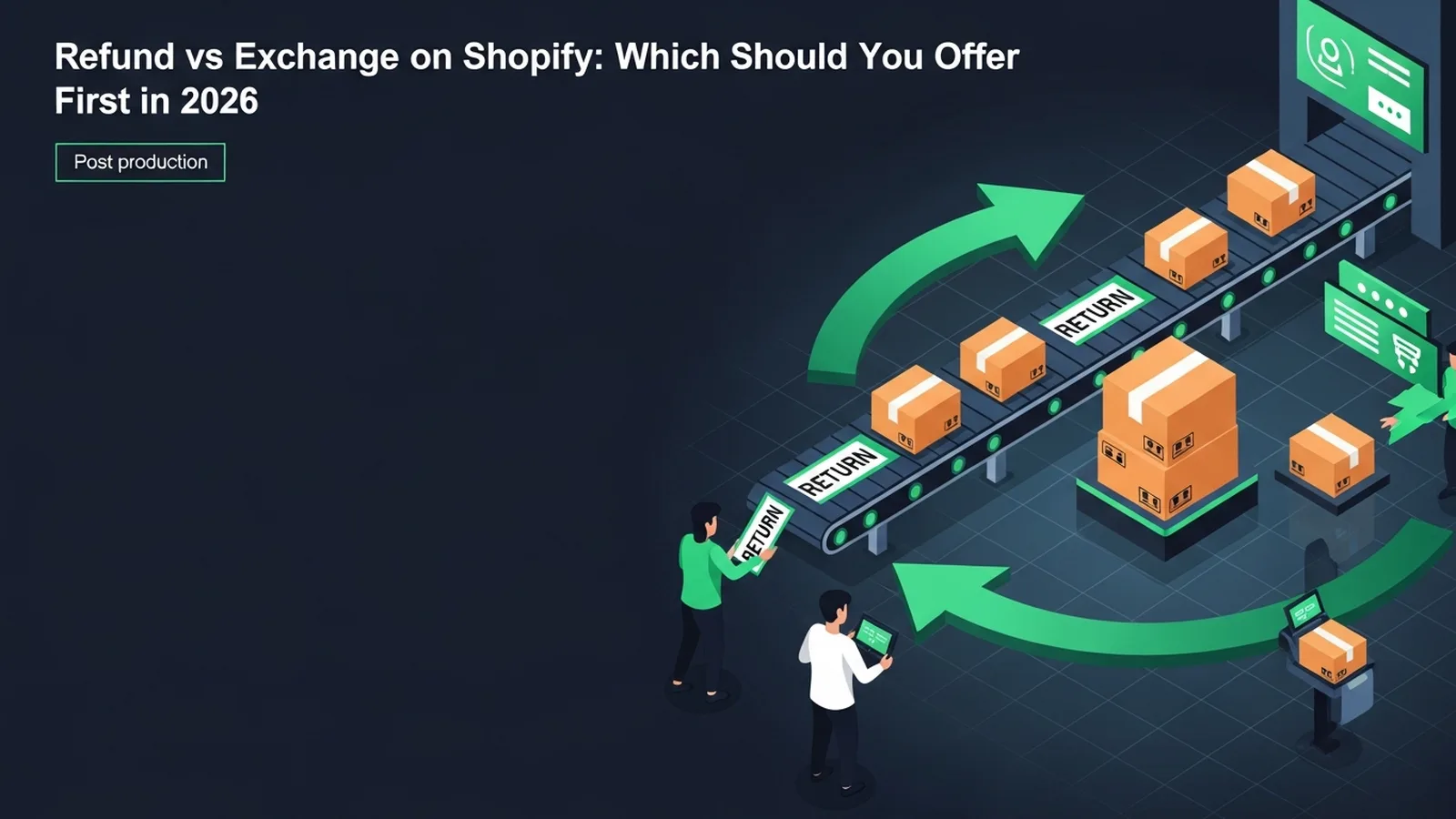
Refund vs Exchange on Shopify: A Revenue-First Decision Framework
TL;DR: TL;DR. Forthroute gives Shopify merchants a branded returns portal with merchant-controlled approvals, refunds and exchange incentives, plus optional prepaid labels.
Last updated: July 2026
TL;DR. Exchange-first checkout flows recover many would-be refunds. See when to offer each, the policy wording that converts, and how to set it up in Shopify.
If you operate returns at scale on Shopify, this guide is one of 25 spokes inside the Shopify Returns Management Hub — start with the pillar for the operator-level overview, then come back here for the deep dive on refund vs exchange shopify. The short answer to "Should I offer refunds or exchanges first on my Shopify store?": work the framework below, ship the policy wording, and instrument the metric we call out at the end.
Why exchange-first beats refund-first
| Dimension | Exchange | Refund |
|---|---|---|
| Revenue impact | Recovers many would-be refunds | Money goes back to the customer |
| Best-fit categories | Apparel, footwear, and accessories, where fit and size variety give replacement options | Consumables, personalized items, final-sale inventory, and high-AOV electronics or furniture |
| Inventory dependency | Offer when the replacement ships in under 5 business days | Default when restock would leave the customer waiting weeks |
| Repeat returns | After two exchanges on the same item, stop pushing a third | Preserves the relationship better than a fourth exchange |
| Customer trust | Show exchange options first with a frictionless path | Fast refunds signal you stand behind your product |
| Seasonal or limited runs | Available for 30 days from purchase | Available afterward |
Why exchange-first beats refund-first is a load-bearing step. The Forthroute team works with Shopify brands on returns, and this is the version of the playbook that survives contact with peak season. Use the rule set below as your default and adjust the thresholds for your category and AOV.
- Define the input you actually have (Shopify order data, return reason, customer cohort).
- Pick a default rule that handles 70% of cases without human review.
- Write the customer-facing wording before you write the rule — the wording is the product.
- Instrument the conversion (refund-to-exchange, repeat-return rate, refund cycle time).
When refund is the right call
When refund is the right call is a load-bearing step. The Forthroute team works with Shopify brands on returns, and this is the version of the playbook that survives contact with peak season.
Use the rule set below as your default and adjust the thresholds for your category and AOV.
- Define the input you actually have (Shopify order data, return reason, customer cohort).
- Pick a default rule that handles 70% of cases without human review.
- Write the customer-facing wording before you write the rule — the wording is the product.
- Instrument the conversion (refund-to-exchange, repeat-return rate, refund cycle time).
Policy wording that nudges to exchange
Policy wording that nudges to exchange is a load-bearing step. The Forthroute team works with Shopify brands on returns, and this is the version of the playbook that survives contact with peak season.
Use the rule set below as your default and adjust the thresholds for your category and AOV.
- Define the input you actually have (Shopify order data, return reason, customer cohort).
- Pick a default rule that handles 70% of cases without human review.
- Write the customer-facing wording before you write the rule — the wording is the product.
- Instrument the conversion (refund-to-exchange, repeat-return rate, refund cycle time).
Shopify setup walkthrough
Shopify setup walkthrough is a load-bearing step. The Forthroute team works with Shopify brands on returns, and this is the version of the playbook that survives contact with peak season.
Use the rule set below as your default and adjust the thresholds for your category and AOV.
- Define the input you actually have (Shopify order data, return reason, customer cohort).
- Pick a default rule that handles 70% of cases without human review.
- Write the customer-facing wording before you write the rule — the wording is the product.
- Instrument the conversion (refund-to-exchange, repeat-return rate, refund cycle time).
Measuring refund-to-exchange conversion
Measuring refund-to-exchange conversion is a load-bearing step. The Forthroute team works with Shopify brands on returns, and this is the version of the playbook that survives contact with peak season.
Use the rule set below as your default and adjust the thresholds for your category and AOV.
- Define the input you actually have (Shopify order data, return reason, customer cohort).
- Pick a default rule that handles 70% of cases without human review.
- Write the customer-facing wording before you write the rule — the wording is the product.
- Instrument the conversion (refund-to-exchange, repeat-return rate, refund cycle time).
Where Exchange-First Doesn't Win
Exchange-first is a default, not a rule, and this guide's own table names the exceptions: consumables, personalised items, final-sale inventory, and high-AOV electronics or furniture, plus any case where the replacement cannot ship quickly.
Forthroute automates either path, free and with no subscription, but it is Shopify-only and it enforces your policy rather than writing it. If the policy pushes exchanges where a refund is fair, automation simply does that faster and more consistently.
Get the policy right first; the tooling only decides how reliably it is applied.
Where ForthRoute falls short
Refunds are merchant-initiated in ForthRoute — one click, but never automatic — and the portal's default resolution is a refund, with exchange offered alongside it rather than ahead of it. ForthRoute tracks the return shipment itself, but it is not a full post-purchase suite: it does not track your outbound orders across carriers or give shoppers a branded order-tracking page for every purchase.
FAQ
Should I offer refunds or exchanges first on my Shopify store?
Yes — and the framework above gives you the operator answer in under 700 words. Exchange-first checkout flows recover many would-be refunds. See when to offer each, the policy wording that converts, and how to set it up in Shopify.
How does this affect refund cycle time on Shopify?
Most operators see refund cycle time drop from 7-9 days to 3-5 days once the rules above are in place. The biggest single lever is auto-approval for low-risk, low-value returns.
Does Forthroute support refund vs exchange shopify natively?
Yes. Forthroute ships with the rule engine, customer portal, and Shopify-native integration the framework above assumes. Pricing is free — see pricing.
Where does this fit in the broader Returns Management Hub?
This spoke is one of 25 inside the Shopify Returns Management Hub. The pillar covers the full operator overview; come back to this spoke when you specifically need to solve refund vs exchange shopify.
Next step
If you want the full operator playbook across all 25 spokes, the Shopify Returns Management Hub stitches them together. If you want to ship this in one afternoon on Shopify, install Forthroute — it's free.
How to Choose Your Default Rule: Decision Trees by Category
The exchange-first framework works differently across product categories. A apparel brand might default to exchange for fit issues but refund for color/style preference.
A D2C beauty brand might offer exchange for defects but refund for shade mismatches, since customers often can't use the wrong tone. The key is matching your default rule to your return reason taxonomy and your margin structure.
Start by auditing your last 90 days of returns: bucket them by reason (fit, defect, style, wrong item, damaged in shipping). For each bucket, note what percentage currently request refunds versus exchanges. That baseline tells you where your customers' expectations already lean. Then, for each reason, ask: can the customer realistically use an exchange, or is the root problem something only a refund solves? If a sweater arrived with a hole, exchange is the right offer. If a customer ordered the wrong size three times, refund may preserve the relationship better than a fourth exchange.
Once you've mapped your rules, document them in plain language—not just for your team, but for your returns portal. When a customer sees "For fit issues, we'll send a free replacement in your new size" versus "Refunds available for all returns," the wording primes them toward exchange. The portal UI should reflect this priority: show exchange options first, make the exchange path frictionless, and surface refund as a secondary choice.
Common Pitfalls: When Exchange-First Backfires
Exchange-first policies work well when your inventory is stable and your return-to-customer time is reasonable. But in three scenarios, pushing exchange can hurt loyalty:
Slow inventory replenishment: If a customer initiates an exchange and waits weeks for restock, they'll regret not choosing the refund. Set a threshold—e.g., "if the replacement ships in under 5 business days, offer exchange; otherwise, default to refund." Tie this to your actual inventory forecasting.
High repeat-return rates: If a customer has already exchanged twice for the same item (fit, color, etc.), offering a third exchange feels tone-deaf. Build a simple flag into your returns logic: after two exchanges on the same order or within a cohort, auto-qualify for refund. Your customer will notice and appreciate it.
Seasonal or limited-run products: If you're selling seasonal apparel or limited drops, exchange may not be possible after a few weeks. For these, state the exchange window upfront: "Exchange available for 30 days from purchase; refund available afterward." This sets expectations and avoids the awkward refusal later.
What Metrics Should You Track?
Once you've launched a refund-versus-exchange policy, measure three things: refund-to-exchange conversion (what percentage of eligible customers choose each option), repeat-return rate (are exchanged items coming back again?), and refund cycle time (how long between approval and money back to the customer).
Conversion is your north star—it tells you whether your policy wording and portal UX are actually nudging customers toward exchange. A healthy baseline is that exchange is chosen in a majority of cases where it's offered, though your industry and customer cohort will vary. Repeat-return rate reveals whether your exchanges are solving the problem or just moving the friction downstream; a spiking repeat-return rate on exchanges suggests your rules are too permissive or your replacement quality is inconsistent.
Refund cycle time is a compliance and experience metric. Set a target (e.g., refunds processed and funds visible within 7 days) and track whether you're hitting it. Slow refunds frustrate customers and increase support tickets; fast refunds, paradoxically, often reduce churn by signaling that you stand behind your product.
Does Exchange-First Work for All Product Types?
Exchange-first is strongest for apparel, footwear, and accessories—categories where fit and size variety give you many replacement options. For consumables, personalized items, or final-sale inventory, refund may be the only honest policy.
For high-AOV items like electronics or furniture, customers often prefer refund because replacement logistics are expensive and inconvenient. The framework adapts: your default rule should reflect what your product and your margin structure can actually afford.
Run Shopify returns in a branded portal you control — Forthroute, no subscription or monthly return limit.
About the Author

Hylke Reitsma is co-founder of Forthsuite and a supply chain specialist with 8+ years of hands-on experience at Shell, Verisure, and Stryker. He holds an MSc in Supply Chain Management from the University of Groningen and writes practical guides to help e-commerce teams run leaner, faster supply chains. Selected by Replit as 1 of 20 founders for the inaugural Race to Revenue Cohort #1 (2026) and certified as a Replit Platform Builder.
LinkedIn