Exchange-First Returns on Shopify
Exchange-first flows offer an exchange alongside the refund. The five UI decisions that move the needle most.
Hylke Reitsma is co-founder of Forthsuite and a supply chain specialist with 8+ years of hands-on experience at Shell, Verisure, and Stryker. He holds an MSc in Supply Chain Management from the University of Groningen and writes practical guides to help e-commerce teams run leaner, faster supply chains. Selected by Replit as 1 of 20 founders for the inaugural Race to Revenue Cohort #1 (2026) and certified as a Replit Platform Builder.
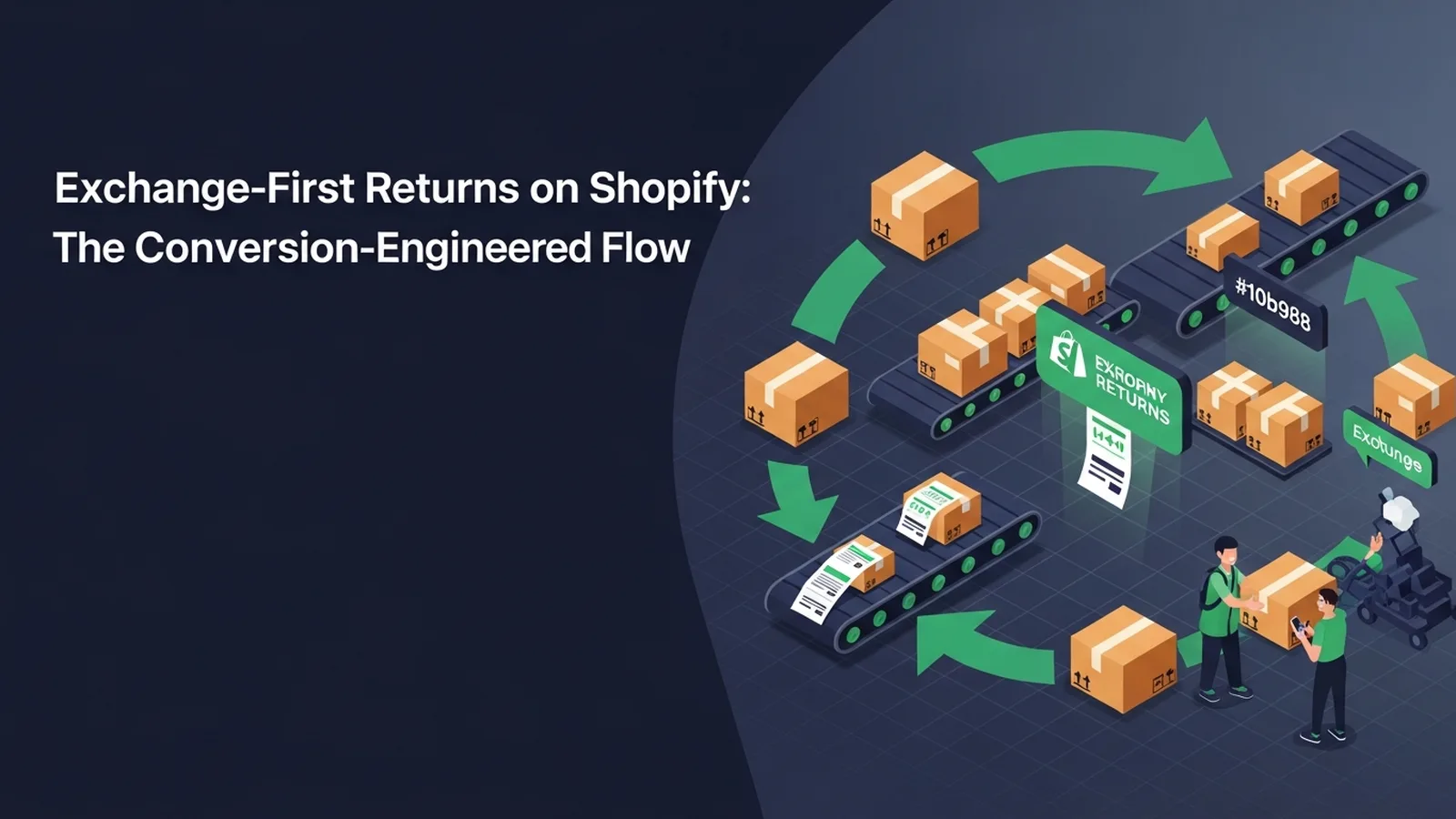
Exchange-First Returns on Shopify: The Conversion-Engineered Flow
TL;DR: Exchange-first return flows offer an exchange alongside the refund, putting a product swap in front of the customer before a cash return. Forthroute gives Shopify merchants a branded returns portal with merchant-controlled approvals, refunds and exchange incentives, plus optional prepaid labels.
Last updated: July 2026
TL;DR. Exchange-first flows offer an exchange alongside the refund, putting a product swap in front of the customer before a cash return. The five UI decisions that move the needle most.
If you operate returns at scale on Shopify, this guide is one of 25 spokes inside the Shopify Returns Management Hub — start with the pillar for the operator-level overview, then come back here for the deep dive on exchange-first returns shopify. The short answer to "How do I build an exchange-first returns flow on Shopify?": work the framework below, ship the policy wording, and instrument the metric we call out at the end.
Why default flows lose money
Why default flows lose money is a load-bearing step. The Forthroute team works with Shopify brands on returns, and this is the version of the playbook that survives contact with peak season.
Use the rule set below as your default and adjust the thresholds for your category and AOV.
- Define the input you actually have (Shopify order data, return reason, customer cohort).
- Pick a default rule that handles 70% of cases without human review.
- Write the customer-facing wording before you write the rule — the wording is the product.
- Instrument the conversion (refund-to-exchange, repeat-return rate, refund cycle time).
The five UI decisions
The five UI decisions is a load-bearing step. The Forthroute team works with Shopify brands on returns, and this is the version of the playbook that survives contact with peak season.
Use the rule set below as your default and adjust the thresholds for your category and AOV.
- Define the input you actually have (Shopify order data, return reason, customer cohort).
- Pick a default rule that handles 70% of cases without human review.
- Write the customer-facing wording before you write the rule — the wording is the product.
- Instrument the conversion (refund-to-exchange, repeat-return rate, refund cycle time).
Recommended-exchange ranking
Recommended-exchange ranking is a load-bearing step. The Forthroute team works with Shopify brands on returns, and this is the version of the playbook that survives contact with peak season.
Use the rule set below as your default and adjust the thresholds for your category and AOV.
- Define the input you actually have (Shopify order data, return reason, customer cohort).
- Pick a default rule that handles 70% of cases without human review.
- Write the customer-facing wording before you write the rule — the wording is the product.
- Instrument the conversion (refund-to-exchange, repeat-return rate, refund cycle time).
Bonus-credit incentive math
Bonus-credit incentive math is a load-bearing step. The Forthroute team works with Shopify brands on returns, and this is the version of the playbook that survives contact with peak season.
Use the rule set below as your default and adjust the thresholds for your category and AOV.
- Define the input you actually have (Shopify order data, return reason, customer cohort).
- Pick a default rule that handles 70% of cases without human review.
- Write the customer-facing wording before you write the rule — the wording is the product.
- Instrument the conversion (refund-to-exchange, repeat-return rate, refund cycle time).
A/B test framework
A/B test framework is a load-bearing step. The Forthroute team works with Shopify brands on returns, and this is the version of the playbook that survives contact with peak season.
Use the rule set below as your default and adjust the thresholds for your category and AOV.
- Define the input you actually have (Shopify order data, return reason, customer cohort).
- Pick a default rule that handles 70% of cases without human review.
- Write the customer-facing wording before you write the rule — the wording is the product.
- Instrument the conversion (refund-to-exchange, repeat-return rate, refund cycle time).
FAQ
How do I build an exchange-first returns flow on Shopify?
Yes — and the framework above gives you the operator answer in under 700 words. Exchange-first flows offer an exchange alongside the refund, putting a product swap in front of the customer before a cash return. The five UI decisions that move the needle most.
How does this affect refund cycle time on Shopify?
Most operators see refund cycle time drop from 7-9 days to 3-5 days once the rules above are in place. The biggest single lever is auto-approval for low-risk, low-value returns.
Does Forthroute support exchange-friendly returns shopify natively?
Yes. Forthroute ships with the rule engine, customer portal, and Shopify-native integration the framework above assumes. There is no software subscription or monthly return limit; optional platform prepaid labels are billed separately — see pricing.
Where does this fit in the broader Returns Management Hub?
This spoke is one of 25 inside the Shopify Returns Management Hub. The pillar covers the full operator overview; come back to this spoke when you specifically need to solve exchange-first returns shopify.
Next step
If you want the full operator playbook across all 25 spokes, the Shopify Returns Management Hub stitches them together. If you want to ship this in one afternoon on Shopify, install Forthroute — there's no software subscription or monthly return limit.
How to sequence the exchange option in your return flow
The order in which you present exchange and refund options shapes behavior. Most Shopify stores show refund first—the default path of least resistance.
To flip this, place the exchange prompt as the primary call-to-action, with refund as the secondary option below it. This isn't dark-pattern design; it's honest sequencing. The customer still sees both paths clearly, but the visual hierarchy signals that exchange is your store's preferred resolution.
Practically, this means your return portal should display the exchange flow above the fold, with the refund button or link positioned lower. Test the button colors too: if your primary CTA is bright and your secondary is muted, you're reinforcing the hierarchy without hiding the refund path. Customers who want refunds will find it; customers who are open to either option will naturally gravitate toward the exchange offer first.
Handling size, color, and condition mismatches in exchanges
An exchange-first flow only works if you can fulfill exchanges reliably. Before you ship a customer to your exchange portal, make sure your inventory data syncs with your return system.
If a customer selects an exchange for a different size or color, your system needs to know whether that SKU is in stock and where it's located in your fulfillment network.
Set clear rules about what condition or damage threshold disqualifies an item from exchange eligibility. For example, you might allow exchanges on sizing issues or color preference mismatches, but exclude items with stains, tears, or missing tags. Document these rules in plain language on your return portal—don't bury them in FAQ or policy pages. The clearer the eligibility criteria upfront, the fewer disputes and re-returns you'll face later.
If a customer requests an exchange but the exact size or color is out of stock, your system should present alternatives automatically. Show similar items sorted by relevance: same product in a different size, or the same size in a similar color. This reduces friction and keeps the exchange path alive even when perfect inventory alignment isn't possible.
What happens when an exchange turns into a return?
Not every exchange succeeds. Sometimes the customer receives the exchanged item and initiates another return.
You need a policy for this scenario before it happens at scale.
Common approaches: allow one free re-exchange, charge a small fee for a second exchange on the same order, or convert a second exchange request into a refund automatically. Whatever you choose, state it clearly when the customer initiates the first exchange. This sets expectations and reduces surprise complaints.
Track this metric separately in your return reporting: of all exchanges initiated, how many convert to a second return or exchange request? High re-return rates on exchanges suggest either poor product-recommendation logic or inventory quality issues. Low rates indicate your exchange matching is working.
Incentivizing exchanges with store credit or shipping credits
One lever many Shopify brands overlook: offering a small bonus incentive for choosing exchange over refund. This might be free expedited shipping on the exchanged item, a small store credit to use on a future order, or both.
The incentive doesn't need to be large—it just needs to tip the decision for customers who are genuinely indifferent between refund and exchange.
The math here is straightforward in principle: if the incentive costs you less than your typical refund processing overhead and chargeback risk, it's worth testing. Make the incentive prominent but not coercive—position it as a thank-you for choosing exchange rather than a penalty for choosing refund.
Measuring exchange-first success: which metrics matter most?
You need three metrics to know whether your exchange-first flow is working. First, track the refund-to-exchange conversion rate: of all return requests in your portal, what percentage choose exchange? Second, measure repeat-return rate on exchanges: of customers who complete an exchange, how many return again within 30 or 60 days? Third, track time-to-resolution: how many days from return request to customer possession of the exchanged item? Fast exchanges build trust; slow ones erode it and often shift customer preference toward refunds.
Run Shopify returns in a branded portal you control — Forthroute, no subscription or monthly return limit.
About the Author

Hylke Reitsma is co-founder of Forthsuite and a supply chain specialist with 8+ years of hands-on experience at Shell, Verisure, and Stryker. He holds an MSc in Supply Chain Management from the University of Groningen and writes practical guides to help e-commerce teams run leaner, faster supply chains. Selected by Replit as 1 of 20 founders for the inaugural Race to Revenue Cohort #1 (2026) and certified as a Replit Platform Builder.
LinkedIn