Automate Tasks When Return Processed Shopify
Automate your Shopify returns: 4 proven workflows (auto-approval, exchanges, store credit, routing) plus a free policy template. Set up self-serve returns with Forthroute.
Hylke Reitsma is co-founder of Forthsuite and a supply chain specialist with 8+ years of hands-on experience at Shell, Verisure, and Stryker. He holds an MSc in Supply Chain Management from the University of Groningen and writes practical guides to help e-commerce teams run leaner, faster supply chains. Selected by Replit as 1 of 20 founders for the inaugural Race to Revenue Cohort #1 (2026) and certified as a Replit Platform Builder.
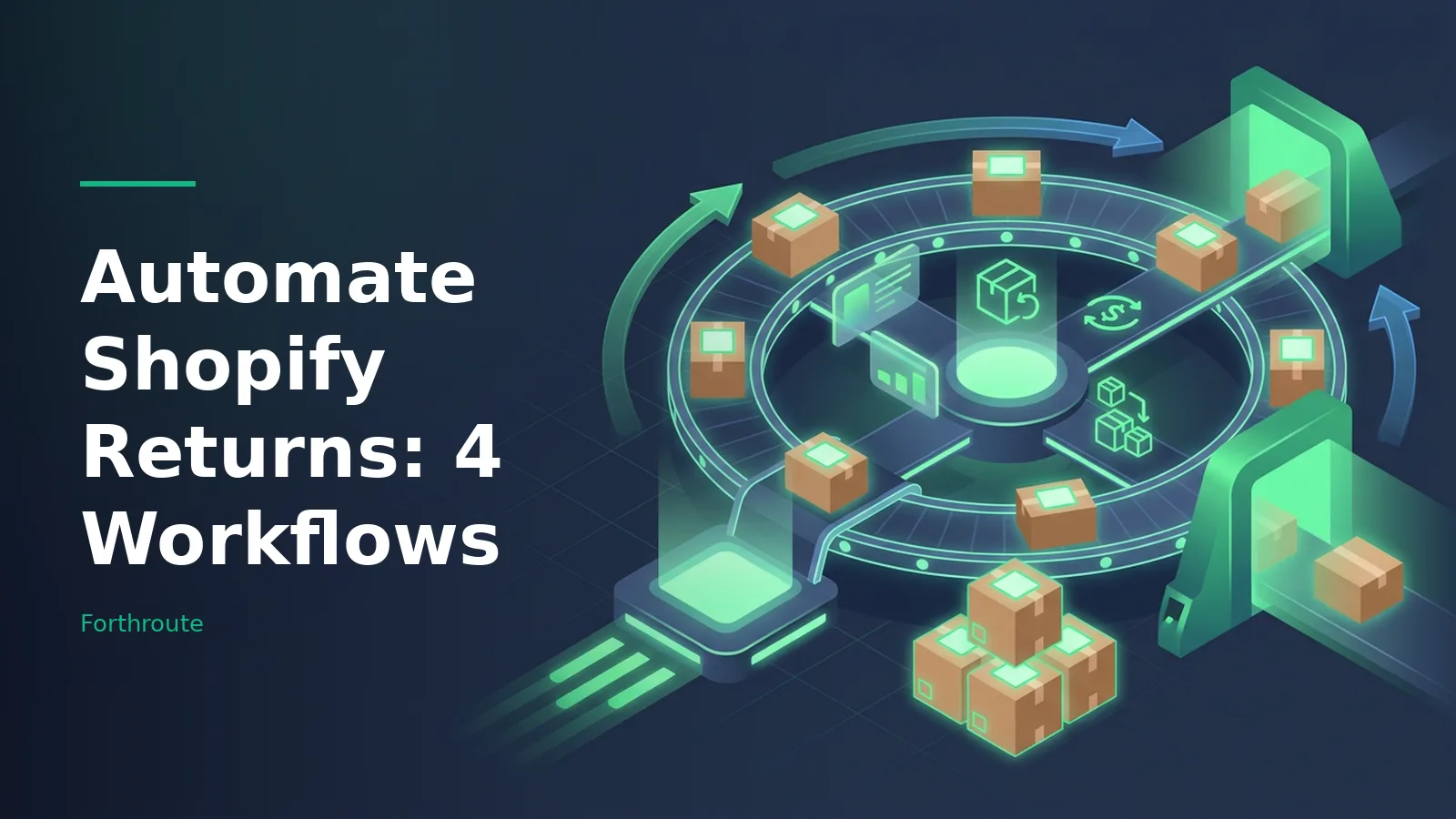
TL;DR: Automate your Shopify returns: 4 proven workflows (auto-approval, exchanges, store credit, routing) plus a free policy template. Set up self-serve returns with Forthroute.
How to Automate Shopify Returns
Last updated: May 2026
TL;DR: Automating Shopify returns pays off because handling returns manually is time-consuming, frustrating for customers, and often leads to lost revenue. Forthroute gives Shopify merchants a branded returns portal with merchant-controlled approvals, refunds and exchange incentives, plus optional prepaid labels.
Handling returns manually is time-consuming, frustrating for customers, and often leads to lost revenue. Automating your Shopify returns process can save time, reduce errors, and encourage exchanges or store credit instead of refunds. Here's how you can do it in five simple steps:
- Install Forthroute: Add the app from the Shopify App Store. Customize a branded self-service portal so customers can start returns easily.
- Set Up Automatic Rules: Configure approval rules for returns based on value, product type, or return window. Automate decisions to save your team time.
- Simplify Shipping: Turn on optional prepaid return labels; where the carrier supports it, customers receive a printerless QR code (currently eligible UK Evri ParcelShop returns) and drop the package at a participating carrier location.
- Promote Exchanges and Store Credit: Offer an exchange or store credit incentive as an alternative to a refund to retain revenue.
- Track Data and Link Your Warehouse: Analyze return trends and connect your warehouse for real-time updates, faster restocking, and accurate inventory.
Forthroute has no subscription or paid tiers: you can automate returns, improve customer satisfaction, and protect your revenue at $0 software cost, with no card details required up front.
Step 1: Install and Configure Forthroute
Add Forthroute to Your Shopify Store

Head over to the Shopify App Store, search for Forthroute, and click Install. Authorize the app in Shopify and work through the setup steps below. No coding skills needed! Forthroute is compatible with every Shopify plan, whether you’re on Basic, Shopify, Advanced, or Plus. You can try it out which is $0 in software cost - no card details required up front. If it’s a good fit, you keep using it at $0 software cost - there is no paid tier to move to. Once installed, the app allows you to integrate seamlessly with your store's branding.
Brand Your Self-Service Portal
With the app installed, it’s time to make the self-service portal match your store’s identity. Start by uploading your logo, choosing your brand’s colors, and tailoring the messaging to fit your tone - whether you want it to feel formal, casual, or sleek and minimalist. After that, use the integration tool to add a "Start a Return" link to your website’s footer menu. This ensures customers can easily locate support options. Once complete, your automated returns workflow is ready to go live.
Step 2: Set Up Automatic Approval Rules
Create Smart Approval Rules
Once your portal is activated, it's time to set up automated rules for handling return requests. Head to the Automated Rules section in your Forthroute dashboard. Here, you can configure your return policy just once, and the system will automatically apply it to all incoming requests.
Start by defining your return window - the period customers have to initiate a return after their order is delivered. Common choices are 14, 30, or 90 days. The countdown usually begins on the delivery date, but if delivery data isn’t available, the system defaults to the fulfillment date plus a transit buffer. Next, identify products that are not eligible for returns, such as final-sale items, perishables, custom goods, or deeply discounted products. These items will be excluded from the portal, so customers can only see eligible products, reducing the chance of invalid requests. Additionally, you can create value-based rules, such as automatically approving returns under $50. This is especially useful for low-value items where the cost of processing might outweigh the product’s value.
With these rules in place, the system takes over, streamlining the approval process without the need for constant oversight.
Reduce Manual Review Work
By automating approvals, you can eliminate the delays caused by manual reviews. When a return request aligns with your rules, Forthroute generates the prepaid shipping label (or, where the carrier supports it, a printerless QR code) without your support team having to intervene. Customers get faster responses, and your staff avoids spending time on routine approvals. The system also integrates with your 3PL or warehouse management system, alerting your fulfillment center whenever an approved return is on its way. For requests that don’t meet your criteria - like those for final-sale items or returns outside the allowed window - the system automatically declines them and provides the customer with a clear explanation. This allows your team to focus on handling unique or complex cases instead of routine tasks.
Step 3: Set Up Shipping Labels and QR Code Returns
Once you've automated return approvals, it's time to simplify the shipping process. Integrated label generation and QR code returns can make this step hassle-free for both you and your customers.
Turn On Prepaid Return Labels
Prepaid labels are optional and off by default. When you switch them on, Forthroute buys a return label for each approved return where a carrier it brokers covers the route, and bills it through Shopify at carrier cost plus a 1% handling markup, rounded up to the next $0.10. Where no brokered carrier covers a route you can connect your own carrier account or let the shopper arrange shipping. When a customer submits a return request through your portal, the label is generated automatically - no manual work required.
To manage shipping costs, head to Shopify's Settings > Policies > Return rules. You can choose whether to:
- Offer free return shipping
- Deduct a flat fee from refunds
- Require customers to purchase their own labels
These settings will only apply to future orders. The cost structure is simple: you pay for a label only when one is actually used. Importantly, you're only charged if the customer actually uses the label.
Enable QR Code Returns
Where the carrier supports it, QR code returns remove the need for customers to print labels.
Forthroute supports printerless QR-code return labels for eligible UK Evri ParcelShop returns; availability depends on the carrier and service. The customer receives a QR code on their phone once the return is approved, brings the package to a participating Evri Print in ParcelShop location, and the label is printed there. The QR label costs the same as the standard prepaid label.
Step 4: Encourage Exchanges and Store Credit
Exchanges and store credit are great ways to keep revenue within your business while addressing customer needs. Here's how you can make these options more appealing than standard refunds.
Guide Customers Toward Exchanges
Forthroute’s portal makes exchanges easy and appealing by showing customers alternative options as soon as they start a return. With just a few clicks, they can choose a different size, color, or even a related product - solving their issue while keeping the sale intact.
Another effective tactic is prioritizing store credit over refunds. Forthroute highlights how offering store credit provides instant value to customers. Instead of waiting for a refund to process, customers can use their credit immediately, giving them a reason to stay engaged with your store while ensuring the revenue remains in your business.
Offer Exchange Incentives Instead of Refunds
Refund is the default resolution in the Forthroute portal, but you can offer an exchange or store credit alongside it and attach an incentive to that option. The merchant sets the incentive; Forthroute does not generate product recommendations.
Exchange incentives keep the sale in your store when the customer simply needs a different size or variant, turning some potential refunds into exchanges without an automated suggestion engine.
sbb-itb-a3e286c
Step 5: Track Data and Connect Your Warehouse
Tracking returns data and linking your warehouse can turn your returns process into a real advantage for your business.
Analyze Return Patterns and Costs
Forthroute’s analytics dashboard helps you uncover return trends and pinpoint reasons. For instance, in apparel, common reasons like "Too big" or "Too small" can reveal sizing issues early on. With these insights, you can adjust inventory strategies and cut down on unnecessary expenses.
One key metric to monitor is your revenue retention rate - how often customers opt for exchanges or store credit instead of refunds. This directly reflects how well your returns workflow is keeping revenue within your business. Additionally, track shipping label costs, which include the the standard carrier rate. Understanding these logistics costs can help you find areas to streamline.
You can also use this data to improve your product pages. For example, if a specific item is frequently returned for being "too small", update the size guide or add a note suggesting customers order a size up. These simple, data-driven updates can make a big difference in reducing future returns. By syncing this information with your warehouse, you ensure prompt action on returns.
Notify Your Warehouse of Incoming Returns
Connecting your warehouse or third-party logistics (3PL) provider ensures returned items are processed and restocked quickly. Give your warehouse team access to the Forthroute dashboard and your return notifications so they see each approved return before the parcel arrives, and agree a simple hand-off for the received, inspected and restocked stages. This keeps delays down and your inventory accurate.
When the approval notification reaches your warehouse, they can prepare for the incoming item. Once the returned product arrives and passes inspection, restock it in Shopify so it is available for purchase again. This closed loop helps you avoid stock shortages and keep customers satisfied. By minimizing delays, this integration also boosts revenue retention and streamlines your operations.
Test Your Returns Workflow Before Launch
Testing your returns process is essential to ensure it delivers fast, accurate customer service while protecting your revenue. Before going live, take the time to confirm every part of the system works as intended.
Run Test Returns
Start by creating a test order in your Shopify admin. Set the order status to "Fulfilled" or "Partially Fulfilled" - returns can only be initiated for orders with these statuses. Use the footer return link and sign in with the test order's email address. You should receive a six-digit verification code via email.
Walk through the entire customer journey: select an item, choose a return reason like "Too big", and pick a resolution - refund, exchange, or store credit. Make sure the system blocks "Final Sale" items and any returns that fall outside your allowed window, whether it’s 14, 30, or 90 days. Double-check that any applicable fees are displayed correctly.
Test the functionality for prepaid shipping labels and QR codes. For printerless returns, ensure the QR code appears clearly on mobile devices, as customers will need to show it at carrier drop-off points. Review the three automated emails (confirmation, approval with label, and decline) to confirm they’re branded properly and include all the right details.
Once you’ve verified every return action, move on to the final pre-launch steps.
Complete Your Pre-Launch Checklist
Simulate different scenarios to make sure the workflow handles everything smoothly. For example, test orders that include both regular and final-sale items, exchanges for a different size, and store credit resolutions. Also, check that the return portal’s design - logo, colors, and fonts - matches the branding of your Shopify checkout page.
Ensure your team receives notifications when a new return request is submitted. If you’re working with a warehouse or a third-party logistics provider (3PL), confirm they receive the return notifications and know the hand-off for received and inspected items. Verify that the return portal link in your footer, refund policy, and order status pages redirects customers to the correct customer accounts login page, not an outdated one.
Lastly, remember that any updates to your return rules will only apply to orders placed after the changes are saved. Use fresh test orders to confirm everything is configured properly.
Conclusion
Using Forthroute to automate your Shopify returns makes the entire process smoother, protects your revenue, and keeps your customers happy. Once set up, you create smart approval rules once and let the system handle everything from there.
The self-service branded portal is a game-changer, giving customers the ability to manage their returns on their own. This not only improves convenience but also cuts down on the number of support tickets your team has to handle. Features like printerless QR code returns (where the carrier supports them) and exchange incentives add even more ease while helping retain more revenue.
On the backend, share the return notifications and dashboard with your fulfillment team so they know when returns are approved, received and inspected. Plus, the analytics dashboard provides a clear overview of return trends and costs, giving you the insights needed to make smarter inventory decisions.
All of this is included at no cost. Shipping labels are only charged when used, keeping your expenses straightforward and manageable.
FAQs
How does Forthroute enhance the return process for customers?
Forthroute simplifies returns with a branded self-service portal that lets customers initiate returns, download shipping labels, or choose exchanges effortlessly. This streamlined approach cuts down on wait times and reduces the need for manual assistance.
Features like exchange incentives and printerless QR code returns (where the carrier supports them) make the process even smoother, ensuring a more convenient experience that boosts customer satisfaction.
How do QR code returns make the process easier for customers?
Where the carrier supports it (currently eligible UK Evri ParcelShop returns), QR code returns remove the printing step. Instead of printing a shipping label, the customer takes the package to a participating drop-off location, shows the QR code on their phone, and the label is printed there.
This streamlined approach not only saves time but also cuts down on effort, creating a smoother and more pleasant return experience for customers.
How does tracking return data improve inventory management?
Tracking return data plays a key role in improving inventory management. It sheds light on why items are being returned and helps identify recurring patterns. This kind of insight enables merchants to tackle common problems, such as product defects or sizing issues, and make smarter choices about stock levels, product adjustments, or even supplier agreements.
When return data is integrated with inventory systems, stock levels can be updated automatically as returns are processed. This reduces the chances of overselling or running out of stock. Plus, automating these updates cuts down on manual errors, boosts efficiency, and ensures inventory records stay accurate. In the long run, leveraging return data effectively supports better product planning, lowers storage costs, and enhances customer satisfaction by ensuring products are consistently available.
Automating Shopify returns is faster when your platform is natively built for it. See our Loop Returns vs Forthroute pricing comparison to compare how Loop Returns and Forthroute handle automation rules, Shopify triggers, and return portal customization.
Returns Management in 2026: The New Landscape
The economics of returns have fundamentally shifted. What was once viewed as a cost-recovery problem is now a retention lever.
Since late 2025, major carriers have restructured reverse logistics pricing—dimensional weight penalties now hit returns harder than outbound shipments, and consolidated return programs offer 15-30% savings over ad-hoc pickups. For high-volume Shopify merchants, this means return shipping costs are no longer a fixed percentage of revenue; they're a variable you can actually optimize.
The bigger change is customer expectation. Buy-online-return-in-store (BORIS) isn't just for enterprise retailers anymore. Mid-market DTC brands are partnering with regional networks and even competitors to offer drop-off points, because customers now expect a return option within 10 miles. If you're running returns solely through carrier pickups, you're leaving resolution time—and repeat purchase rates—on the table. Automation that routes returns based on item value, condition, and proximity to distribution points is becoming table stakes.
Watch for the rise of condition-based routing intelligence. Returns platforms are starting to integrate with recommerce and liquidation channels in real-time, meaning a returned item can be rerouted to a B2B buyer or refurbisher before it ever hits your warehouse. The operators winning in 2026 treat returns as inventory in motion, not inventory coming home.
Run Shopify returns in a branded portal you control — Forthroute, no subscription or monthly return limit.
About the Author

Hylke Reitsma is co-founder of Forthsuite and a supply chain specialist with 8+ years of hands-on experience at Shell, Verisure, and Stryker. He holds an MSc in Supply Chain Management from the University of Groningen and writes practical guides to help e-commerce teams run leaner, faster supply chains. Selected by Replit as 1 of 20 founders for the inaugural Race to Revenue Cohort #1 (2026) and certified as a Replit Platform Builder.
LinkedIn