Manual Returns vs Automated Returns: Which Wins in 2026
Automate return intake, rules and labels; keep human review for exceptions, inspection and refunds. Compare manual, automated and hybrid workflows.
Hylke Reitsma is co-founder of Forthsuite and a supply chain specialist with 8+ years of hands-on experience at Shell, Verisure, and Stryker. He holds an MSc in Supply Chain Management from the University of Groningen and writes practical guides to help e-commerce teams run leaner, faster supply chains. Selected by Replit as 1 of 20 founders for the inaugural Race to Revenue Cohort #1 (2026) and certified as a Replit Platform Builder.
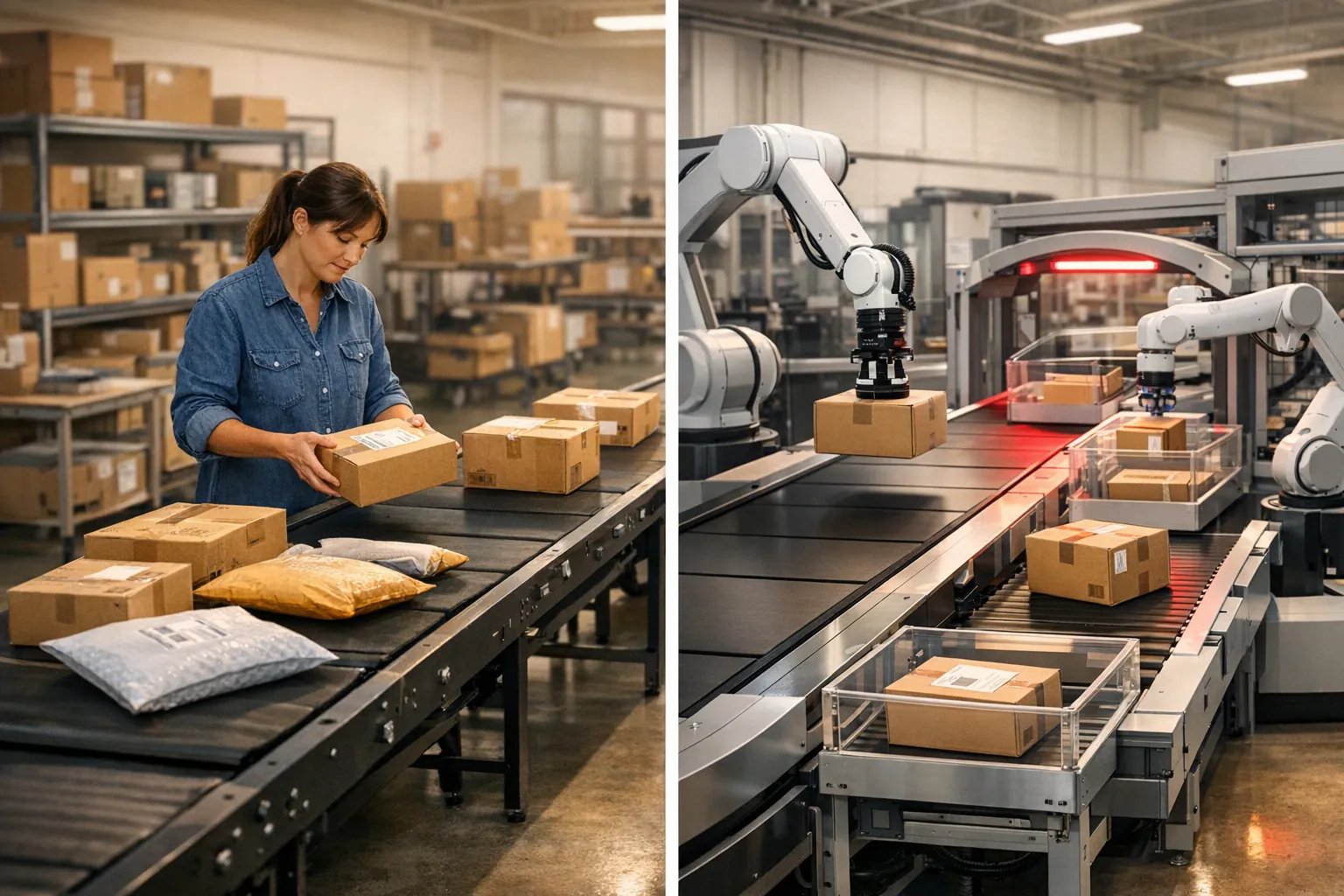
TL;DR: Automation usually wins for repetitive return intake, eligibility rules, labels, and status updates. Manual review still wins for exceptions, physical inspection, disposition, and refund decisions. For most Shopify merchants, the practical winner is a hybrid workflow that automates predictable steps and assigns judgement to a person.
Last updated: August 2026
The short answer: automate repetition, keep judgement
Automated returns win when a step follows a stable rule and repeats often; manual handling wins when the decision depends on context, product condition, fraud risk, or customer history. A hybrid workflow combines both instead of pretending that every return can run without review.
| Workflow choice | Best use | Main limitation |
|---|---|---|
| Manual | Rare, unusual, high-value, or judgement-heavy cases | Staff must repeat intake, communication, and record updates |
| Automated | Stable eligibility rules, routine labels, and status communication | Rules cannot inspect a physical item or resolve every exception |
| Hybrid | Routine requests plus a clear exception queue | Requires owners, escalation rules, and tested handoffs |
What manual and automated returns mean
A manual return relies on staff to capture the request, check policy, communicate next steps, and record each decision. An automated return uses software for defined parts of that sequence, but automation can cover one step without owning the entire return.
A return merchandise authorization (RMA) is the record that identifies an approved or requested return and its items. A self-service portal can collect an RMA request, while the merchant can still decide whether to approve it and what resolution to offer.
A return is a chain of separate decisions
Return intake, approval, shipping, receipt, inspection, disposition, exchange, restock, and refund are separate events. Shopify's returns-app lifecycle guidance assigns eligibility, approval, tracking, restock, exchange, and refund as distinct merchant actions rather than one automatic outcome.
- Request: The customer identifies the order, item, reason, and preferred resolution.
- Eligibility: A rule or reviewer checks the return window, item status, policy exclusions, and available options.
- Authorization and shipping: The merchant approves or declines the request and supplies instructions or a label where appropriate.
- Receipt and inspection: A warehouse, store, or third-party logistics provider (3PL) confirms what arrived and its condition.
- Disposition and money: The merchant decides whether to restock, repair, dispose, exchange, issue store credit, or refund.
Shopify's return-management guide also separates calculating the financial impact from creating and processing a return. That distinction matters because an estimate, an approved request, and money returned to a customer are not the same event.
Where automation wins
Automation wins where inputs are structured, policies are explicit, and the next action is predictable. It reduces repeated data entry and gives customers a consistent route into the process without removing the merchant's control over exceptions.
- Automation wins when: customers can identify an order and item through a portal.
- Automation wins when: return windows, exclusions, fees, and routing rules are defined in advance.
- Automation wins when: approved requests need standard instructions, labels, tracking, and status messages.
- Automation wins when: staff need one queue and a consistent audit trail instead of scattered email and spreadsheets.
The safe benefit claim is operational: software can standardise and route repeatable work. The evidence collected for this review does not support a universal processing-time, cost-saving, error-rate, revenue-retention, or volume threshold.
Where manual review still wins
Manual review wins when the policy cannot determine the fair or safe outcome from request data alone. A person or operational team must also handle physical tasks that a customer portal cannot perform.
- Manual review wins when: the item is high value, damaged, incomplete, unusual, or potentially fraudulent.
- Manual review wins when: customer history, warranty terms, duties, bundles, or partial fulfilment change the resolution.
- Manual review wins when: the returned product must be received, inspected, graded, repaired, restocked, or disposed.
- Manual review wins when: a refund, exchange, store-credit amount, or goodwill exception needs authorisation.
Shopify's return-processing reference makes the boundary explicit: processing confirms returned and exchanged quantities, applies a disposition, and can optionally issue a refund. Those are controlled actions, not proof that a return request should trigger money movement automatically.
A practical decision matrix
The best workflow assigns each return step to a rule, a person, or an operational system before volume creates ambiguity. This matrix is an explanatory decision aid, not a performance benchmark.
| Return step | Default owner | Escalate when |
|---|---|---|
| Request capture | Portal or structured form | The order or item cannot be identified |
| Policy check | Rules for routine cases | An exclusion, warranty, or exception applies |
| Approve or decline | Rules only where the merchant has authorised them | Risk, value, or context requires judgement |
| Label and instructions | Shipping integration after approval | Coverage, customs, or product handling differs |
| Receive and inspect | Warehouse, store, or 3PL | Condition or contents do not match the request |
| Disposition | Merchant's operational policy | Repair, resale, disposal, or inventory treatment is unclear |
| Refund or exchange | Merchant-authorised action | Amounts, stock, payment, or customer terms differ |
Hybrid workflow: Use software to collect consistent inputs and route ordinary cases, then surface a small, explicit queue for merchant and warehouse judgement. The goal is not zero human involvement; it is to spend human attention where rules are insufficient.
What the embedded video actually covers
The Explified Labs video illustrates warehouse-side sorting, condition checks, disposition, and restocking technology. It is relevant to the physical stage after an item comes back, but it is not the full customer-return workflow and does not validate the removed benchmarks or our product's capabilities.
Video text equivalent: The video follows a returned item through warehouse barcode scanning, camera-assisted condition checks, sorting by disposition, and technology-assisted restocking. It presents broad automation benefits, so this guide uses it only to explain that warehouse sorting and restocking form a separate operational layer after request intake and approval.
Where our Shopify returns app fits—and stops
Disclosure: Forthroute is our Shopify returns app, so this section is a disclosed product-fit note rather than an independent review. It supports a branded customer portal, configurable policies, request review, approved-return labels, exchange options, merchant-issued refunds, notifications, and return-leg tracking.
- Best fit: A Shopify merchant that wants structured return requests, policy controls, labels, exchanges, and a merchant review queue.
- Not a fit: A non-Shopify merchant, a team seeking a physical return centre or carrier network, or an operation expecting autonomous refunds and warehouse work. Forthroute does not receive, inspect, or restock returned products; the merchant, warehouse, or 3PL owns those steps.
- Price: The Shopify App Store listing currently lists the software as Free. Optional prepaid labels are billed through Shopify when purchased, or a merchant can connect its own carrier account.
- Setup: Install the app, configure return policies and resolutions, connect the chosen label route, and test both an ordinary case and an exception before exposing the workflow broadly.
- Time to value: No fixed time-to-value is promised; readiness depends on policy decisions, carrier setup, theme placement, data quality, and testing.
- Alternatives: Shopify's native return tools may cover a simple workflow; manual handling can suit rare or unusual cases; broader return platforms may fit non-Shopify or multi-channel requirements.
- Next step: Map the decision matrix to the current process, identify the steps Forthroute can structure, and keep named owners for inspection, disposition, and the action where the merchant issues the refund.
Implementation checklist
A reliable hybrid workflow starts with policy and ownership before software configuration. Test the handoffs with ordinary and exception cases, then review the resulting queue and records.
- List every return event from request through closure and name its system or human owner.
- Write eligibility, fee, exclusion, and approval rules in plain language before encoding them.
- Define which conditions always escalate to merchant, fraud, customer-service, or warehouse review.
- Separate request approval from receipt, inspection, disposition, and refund authority.
- Test labels, notifications, exchange inventory, and refund amounts with a reversible test case.
- Review exceptions and rule overrides regularly; a rule that creates repeated exceptions needs revision.
The verdict
Automated returns win the repetitive parts of a stable process, while manual review wins the decisions that require judgement or physical evidence. Most merchants should choose a hybrid workflow: automate intake, rules, labels, tracking, and communication, then preserve accountable review for exceptions, inspection, disposition, and refunds.
This verdict fulfils the page's comparison without claiming that automation is universally faster, cheaper, error-free, or autonomous. The right measure is whether each step has a reliable input, an authorised action, and a named owner when the rule cannot decide.
Related reading
Continue with Forthroute's guides to store credit versus refunds and return-management platforms.
FAQs
Are automated returns always better than manual returns?
No. Automation is better for stable, repeated steps; manual review is better for exceptions, physical inspection, and decisions that depend on context. A hybrid process is usually more defensible than either extreme.
Can returns software inspect an item and issue the refund automatically?
Software can collect a request, apply authorised rules, generate instructions, and record status. Physical inspection still belongs to a warehouse, store, or 3PL, and Forthroute refunds are merchant-initiated rather than triggered automatically.
When should a small Shopify store automate returns?
Automate when repeated intake, policy checks, labels, or communication create avoidable work or inconsistency. No universal return-count threshold is supported here; use process complexity, exception frequency, policy stability, and staff effort to decide.
About the Author

Hylke Reitsma is co-founder of Forthsuite and a supply chain specialist with 8+ years of hands-on experience at Shell, Verisure, and Stryker. He holds an MSc in Supply Chain Management from the University of Groningen and writes practical guides to help e-commerce teams run leaner, faster supply chains. Selected by Replit as 1 of 20 founders for the inaugural Race to Revenue Cohort #1 (2026) and certified as a Replit Platform Builder.
LinkedIn